When a garage door comes off its track, stop using it, unplug the opener and keep everyone away, because it can fall. Do not lift it, force it with the opener or touch the spring and cable brackets. In White Rock, sloped driveways, tight garages and salt air on rollers and cables are common causes. Most off-track repairs are done on the first visit in 1 to 3 hours.
First, leave the door where it is
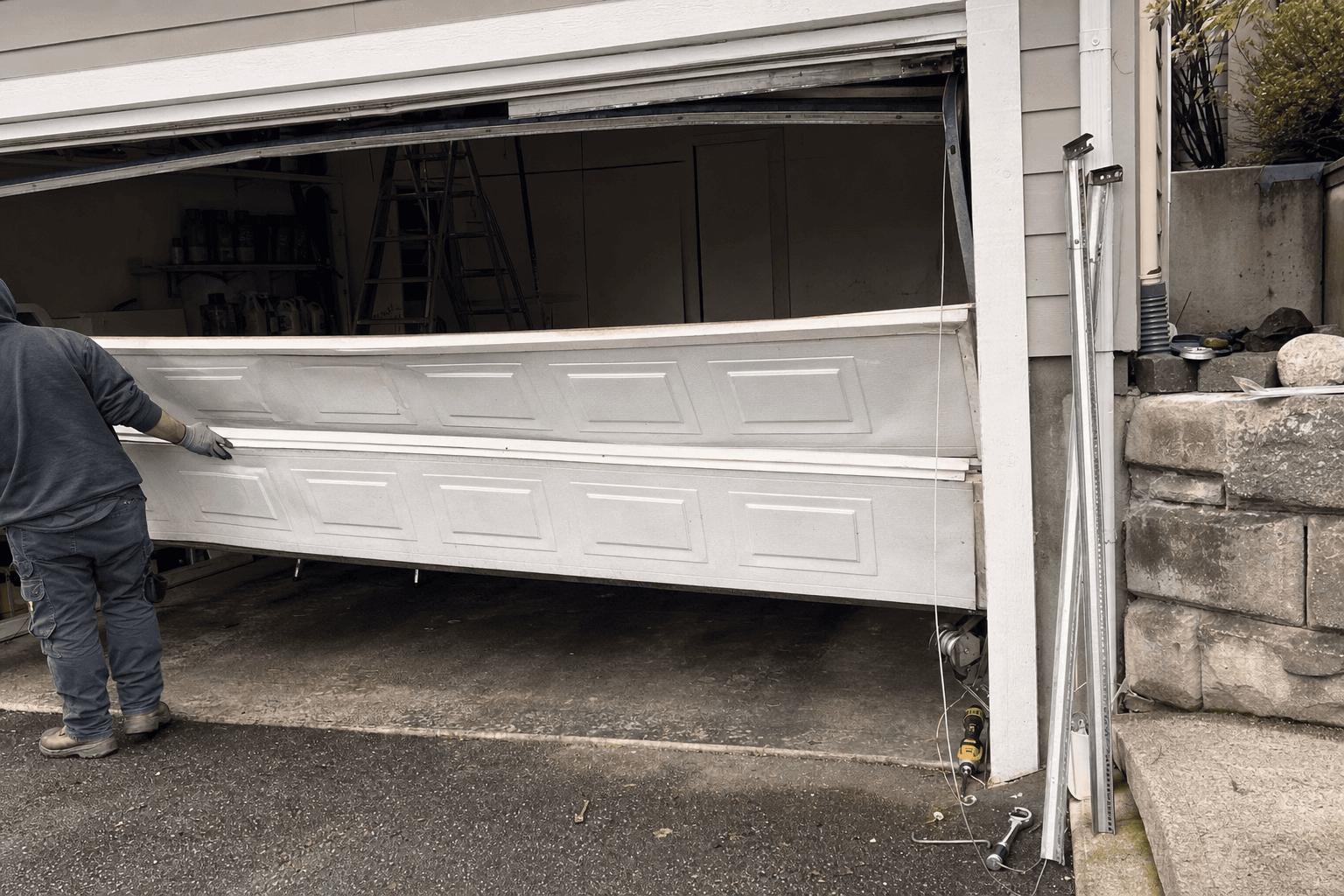
If your garage door has come off its track and is hanging crooked, stop using it. Do not press the opener button again, do not try to lift it back into place, and keep people, pets and cars away from the opening. An off-track door can fall, and the springs above it may still be under tension.
Then do three things:
- Unplug the opener, or switch off its breaker, so nobody runs it by accident.
- Move anything fragile out from under the door if you can do it without standing beneath it.
- Take a few photos from inside and outside. They help whoever repairs it bring the right parts.
If the car is stuck inside, it stays inside for now. That is the hard part, but forcing a crooked door is how panels crack and cables snap.
Why doors jump the track in White Rock
White Rock has a few local reasons for off-track doors that come up again and again.
Steep, sloped driveways
Many homes step up the hillside above Marine Drive, with tight driveways and retaining walls. On a sloped garage floor the door does not sit flat when it closes. One side touches down first, the other side keeps pulling, and over time the rollers get pushed out of the track. A door that closes unevenly is often a warning sign.
Tight garages
Older bungalows in Hillside, Five Corners and near East Beach often have small garages. A car parked close to the door, a bike on a hook or a storage shelf near the track is easy to clip. One knock can bend a track or pop a roller out.
Salt air on the hardware
Homes near West Beach and East Beach take salt spray off Semiahmoo Bay. Salt rusts tracks, rollers and cables faster. A rusted roller drags instead of rolling, and a frayed cable can let one side of the door drop. Either can pull the door out of line.
What you can safely check
You can look, as long as you are not under the door or touching the springs and cables.
- Which side is off: is one roller out, or several down one side?
- Cables: does a cable hang loose or look unwound from the drum at the top?
- Springs: is there a gap in a spring above the door or along the tracks?
- Tracks: is a track bent, or pulled away from the wall?
- Panels: is a section cracked or folded where the door twisted?
A loose cable or a broken spring changes the job. It means the door is not being held up properly on one side, and it is even more important not to move it.
What not to do
- Do not use the opener to "pull it back in". The motor can bend the door further.
- Do not hammer a roller back into the track while the door is hanging.
- Do not loosen the bolts on the spring brackets or the bottom brackets. These hold the cable ends and are under load.
- Do not leave it half open overnight with someone planning to fix it in the morning by hand.
What the repair usually involves
Most off-track repairs are done on the first visit and take 1 to 3 hours. The usual steps are:
- securing the door so it cannot drop while it is worked on
- taking tension off the springs if a cable is involved
- getting the door back into the tracks and replacing any cracked or rusted rollers
- straightening or replacing bent track sections and tightening the brackets
- replacing a frayed or snapped cable, then resetting the spring tension so the door balances
- checking hinges and the bottom seal, then running the door by hand and on the opener to test the safety reverse
Most door repairs run $200 to $500, depending on the parts needed. Replacing a damaged panel costs more, and depends on whether matching panels are still made. We check the whole door before touching the opener and give a quote before any work starts. If a door is stuck shut with your car inside, a same-day visit is often possible when the schedule allows.
Keeping it on track afterwards
- Keep the area beside each track clear of shelves, bikes and bins.
- Watch how the door closes on a sloped floor. If one side lands first and the door jerks, have the bottom seal and balance looked at.
- Near the beach, look at the rollers and cables every few months for rust and fraying.
- Book a yearly tune-up to check balance, lubricate the moving parts and test the safety reverse.